
County Official Details Solar Farm Oversight, State Limits at GOP Meeting
By Andrea Arens
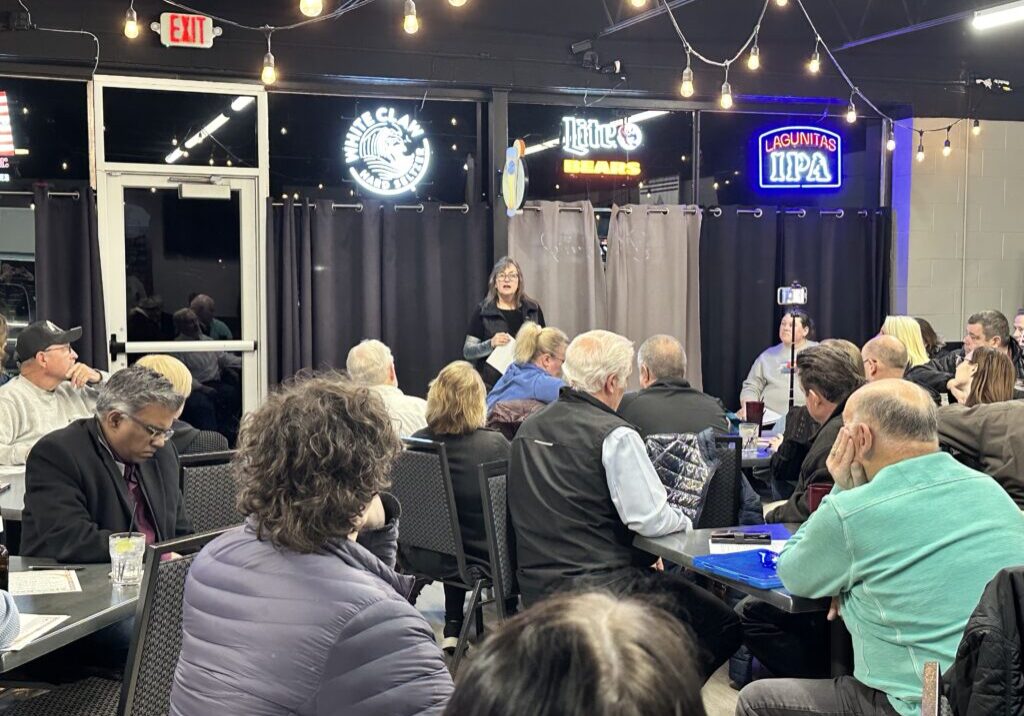
NEW LENOX — Will County Board member Judy Ogalla outlined the county’s evolving role in regulating solar farms and the growing influence of state legislation during an informational meeting hosted by the New Lenox Republicans.
What started as an informational meeting with the expectation of minimal attendance, turned into a much bigger meeting with more than 50 people in attendance and standing room only at the JBD White Horse Inn in New Lenox on January 7.
Ogalla, a Republican who has served on the county board for 14 years, told attendees that while Illinois has embraced renewable energy, counties have steadily lost authority over where and how large solar facilities can be built.
“Springfield has made it very clear that solar is allowed in Illinois,” Ogalla said. “The problem is that they continue to take more and more siting authority away from counties.”
How Solar Projects Are Approved
Ogalla explained that solar farm proposals begin with the county’s Planning and Zoning Commission. If approved there, projects move to the county board’s Land Use Committee, which decides whether to grant a special use permit.
Since solar projects began appearing in Will County in earnest, 84 applications have been submitted. Of those, 17 were withdrawn, often after developers failed to secure state subsidies. The county board has approved 57 projects and denied 10.
Currently approved projects account for roughly 180 megawatts of solar capacity across approximately 1,455 acres — about 0.67 percent of Will County’s 216,000 acres of farmland.
“That sounds small on paper,” Ogalla said, “but if you live next to one, it feels very large.”
Focus on Residential Impacts
Ogalla said the county shifted its approach as projects began encroaching on municipalities, rural subdivisions, and homes.
“We decided that if something is very close to residential areas — whether in a municipality or a rural subdivision — that’s where we would focus our denials,” she said.
She emphasized that many residents choose rural living to avoid industrial-style development.
“You live in the country to live in the country, not to have an industrial facility next door,” she said.
New State Laws Restrict Counties
Ogalla said recent legislation, including bills passed in 2023 and additional measures expected to take effect later this year, further restrict counties from imposing regulations beyond state standards.
Under the new laws, counties cannot adopt requirements more restrictive than state rules for setbacks, fencing, landscaping, or decommissioning. Counties also cannot prohibit solar facilities in agricultural zoning districts.
“This makes it harder and harder for us to say no without being taken to court,” Ogalla said.
She added that Will County is currently involved in solar-related litigation, with the next court date scheduled for Jan. 26.
Fees, Inspections, and Infrastructure
Ogalla said developers are required to pay application fees and meet with local townships, fire districts, and road commissioners. The county also now requires underground utility lines after discovering that burying them was feasible.
“We learned that ComEd doesn’t care if the lines are buried or not,” Ogalla said. “So now we require them to bury them. It makes a big difference in rural aesthetics.”
She also acknowledged gaps in enforcement, particularly during construction.
“They do a lot of self-reporting,” Ogalla said. “That’s a problem.”
Community Concerns Raised
Attendees raised concerns about soil erosion, stormwater runoff, wildlife disruption, fencing, heavy metals, battery storage, and damage from severe weather. Others questioned whether solar panels and related infrastructure could affect groundwater and septic systems.
Ogalla said decommissioning bonds are required to ensure removal of equipment when projects end, though she acknowledged uncertainty about long-term land restoration.
She also addressed concerns about farmland being sold at prices far exceeding agricultural value, sometimes to out-of-state developers.
“When land is selling for $50,000 an acre, that’s hard for anyone to turn down,” she said.
Calls for Political Action
Several speakers criticized state lawmakers for removing local control and urged residents to contact legislators and become politically active.
Tom Becker, Chairman of the Green Garden Watershed Committee, spoke about the proposed solar farm in Green Garden that would encompass possibly anywhere from 6,000-10,000 acres in a possible 2 phase project that might have ties to a data center in Joliet.
“It is so draconian, it is a transition of the largest farming district in Will County, into industrialization. There is no change. Once you put 6,000 acres of this industrial utility, all the surrounding area will transition to commercial and industrial, and we will lose any future residential growth, and we will lose the farming district. That’s the predictable result of this kind of corporate takeover of our area,” said Becker.
Becker encouraged people to sign the petition he is circulating on the Green Garden Township website and added that the best prevention is to change the law; adding that litigation is a next step.
Ogalla said counties have little recourse beyond legal challenges and elections.
“We’ll continue to do the best we can at the county level,” she said. “But until the law changes, our hands are tied.”




Mostly Sunny