
Peotone Hosts Open House, Planning Commission Discussion on Proposed Historic Overlay District
By Andrea Arens
The Village of Peotone continues to move forward with plans to establish a Historic Overlay District aimed at preserving and enhancing the historic character of its downtown area.
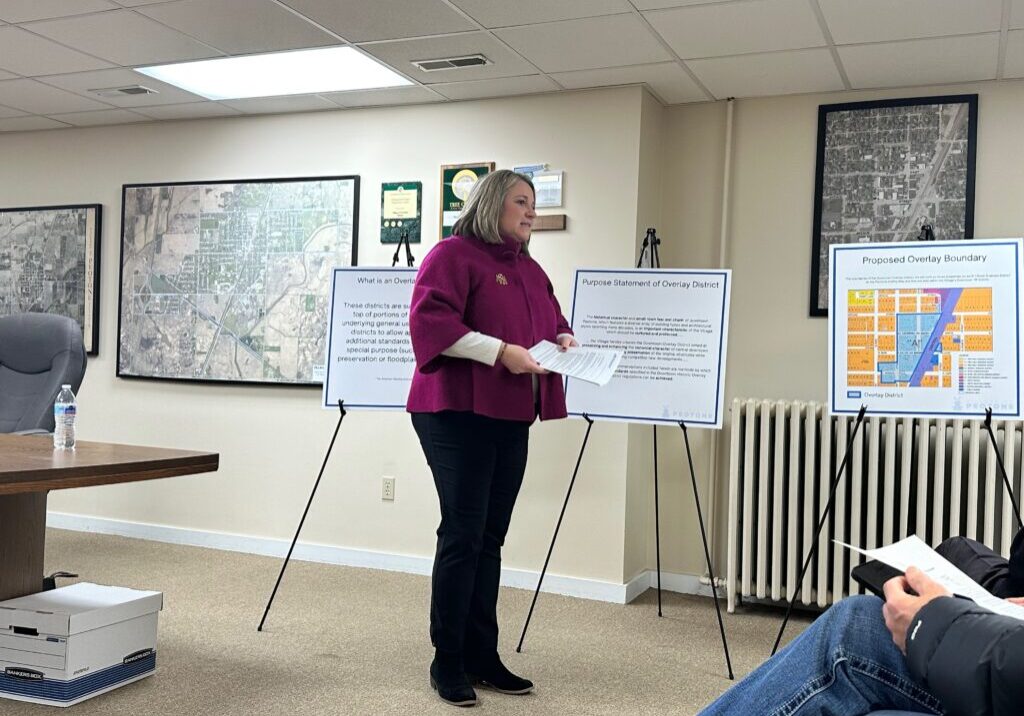
An open house was held ahead of the most recent Planning and Zoning Commission meeting, giving residents and property owners an opportunity to learn more about the proposed Historic Overlay District standards, ask questions, and provide feedback. The district boundaries mirror those of the existing downtown Tax Increment Financing (TIF) district.
Maura Rigoni of Robinson Engineering led the open house presentation, walking attendees through the proposed Historic Overlay District standards, the review process for building improvements, and the anticipated timeline for final approval. The standards would be adopted through a village ordinance and incorporated into the zoning code.
Rigoni emphasized that most downtown buildings are already in compliance with the proposed standards. Existing non-compliant materials would not be required to be replaced unless a property owner applies for a remodel or improvement.
How the Overlay District Would Work
Under the proposal, routine building maintenance would not require review. However, exterior improvements beyond regular maintenance would be evaluated using an “improvements calculation worksheet,” which has yet to be finalized. The worksheet would be completed by the village administrator under the ordinance, with the option to engage a consultant at the property owner’s expense if needed.
The level of review would depend on the scope of the work:
- Limited improvements (10% or less): Standard permit only
- Minor improvements (greater than 10% but less than 45%): Review by the village administrator using the worksheet
- Major improvements (greater than 45%): Worksheet, Planning and Zoning Commission review, and Village Board approval
The village administrator would have authority to approve projects totaling less than 45%.
Demolitions within the overlay district would require approval, and any vacant lot resulting from demolition would need to be landscaped within 60 days. Waivers could be requested if a proposed change does not impact a building’s architectural style.
Design Standards and Restrictions
The proposed standards include restrictions intended to preserve the historic appearance of downtown buildings. Prohibited materials include unfinished concrete, precast concrete block, vinyl siding, and steel siding. Ground-floor windows would be required to remain transparent, and historic window sizes and designs would need to be maintained.
Additional standards include screening rooftop equipment from public view, guidelines for solar panel placement, and the use of historically appropriate color palettes from major paint manufacturers.
Attention-getting devices and LED signs would be prohibited. Temporary signs would be limited and could not cover more than 50 percent of a window. Outdoor storage would not be allowed unless approved through a special use permit in accordance with village code.
Public Feedback and Concerns
Questions about approved building materials, particularly the restriction on vinyl siding, generated discussion during the open house. Rigoni suggested fiber-cement products such as Hardie board as a possible alternative, which drew criticism from resident Chris Bowen.
“Who decides what we get to use? Hardie board is crap,” Bowen said. “You need to get somebody that knows construction; that knows the business.”
Rigoni responded that modern building materials differ from those used historically and encouraged continued public input to help refine the standards, noting that the document is intended to function as a guide while still being enforceable.
She also pointed to the multi-layered review process as a safeguard, noting that only major improvements would require Planning and Zoning Commission and Village Board involvement.
Facade Improvement Program
The Historic Overlay District would work alongside a proposed village facade improvement program. The program would offer grants of up to $25,000 for exterior facade improvements, helping property owners offset the cost of complying with the new standards.
Village Administrator Nick Palmer said the village’s goal is to work collaboratively with property owners rather than take a punitive approach.
Planning and Zoning Commission Update
Following the open house, the Planning and Zoning Commission continued its working session on the proposed text and map amendments needed to establish the overlay district.
Rigoni and Palmer reviewed changes made since the previous planning and zoning meeting, including clarifying language, strengthening design standards, refining the demolition review process, and addressing signage, outdoor storage, and solar panel standards. The commission also discussed the importance of ensuring public notification and a formal public hearing process.
The commission plans to formally post the text and map amendments for a public hearing at its February 18 meeting. If recommended, the proposal could advance to the Village Board for consideration later in February or early March.
Residents and property owners will continue to have opportunities to provide feedback as the process moves forward.






Scattered Showers And Thunderstorms then Mostly Sunny