
Will County P&Z Recommends Denial of 6,000-Acre “Pride of the Prairie” Solar Project After Contentious Hearing
By Andrea Arens
JOLIET — After more than eight hours of testimony and public comment spanning two nights, the Will County Planning and Zoning Commission voted 4–2 to recommend denial of a controversial 6,099-acre solar development proposed by Earthrise Energy.
The “Pride of the Prairie” project, filed under Case ZC-25-129 by Lincoln Solar Energy LLC, would span 96 non-contiguous parcels across Manhattan, Green Garden, and Wilton Townships and generate up to 600 megawatts of electricity. The proposal required a single special use permit along with 195 variances.
The March 31 vote sends the project to the Will County Land Use and Development Committee with a negative recommendation.
A Project of Unprecedented Scale
Earthrise representatives opened the March 30 hearing with a roughly 90-minute presentation outlining the project’s scope, economic impact, and infrastructure strategy.
“We develop at the transmission scale. We sell into the wholesale market, and for that to be cost-effective, you really have to do it at scale,” said Rob Kalbouss, Director of Development for Earthrise Energy. “Because our strategy involves interconnecting at these peaking plants, that’s really defining the capacity.”
The project is designed to connect to an existing interconnection at the Lincoln Generating Station, a natural gas peaker plant in Manhattan that Earthrise recently acquired. Plans also include a second substation, which would require additional approvals.
Earthrise estimates the project would generate $3.5 million in property tax revenue in its first year and approximately $81 million over its 35-year lifespan. Peotone School District 207-U alone is projected to receive $1.8 million in year one.
The company also confirmed that roughly 300 megawatts of the project are already under contract through Illinois Power Agency procurements in 2023 and 2024.
Despite those projections, commissioners questioned both the long-term valuation model—currently based on a statutory rate of $218,000 per megawatt—and whether the project would meaningfully add capacity to the grid.
“I can’t buy the argument that it’s adding capacity to the grid,” Commissioner John Kiefner said, noting the limited operation of the peaker plant.
Public Comment Dominates
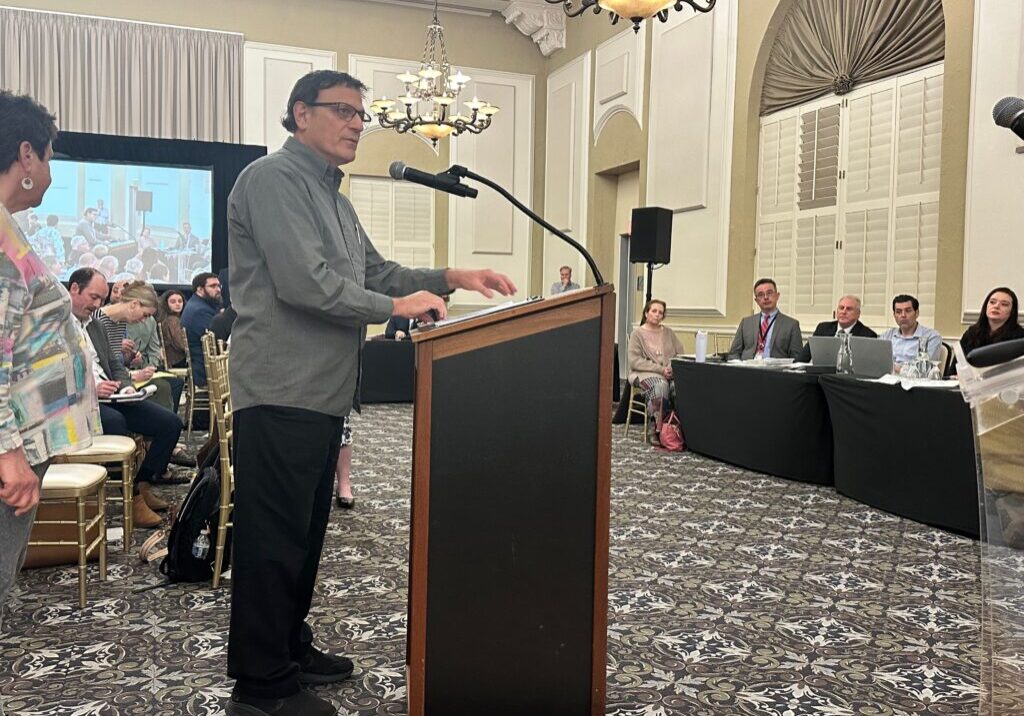
The hearings drew a packed crowd at the Renaissance Center in Joliet, with more than 80 to 100 people signing up to speak. Public comment stretched late into both evenings, with Chairman Hugh Stipan repeatedly calling for order amid applause and jeers from a divided audience.
Supporters included union labor representatives, environmental advocates, and some landowners who emphasized property rights. Labor groups testified the project could support hundreds of construction jobs, including union positions under a project labor agreement.
Opposition, however, was broader and more sustained, led by nearby residents, farmers, and local officials who raised concerns about land use, environmental impacts, and the project’s scale.
Green Garden Township Supervisor Dean Christofilos submitted a formal objection, arguing the project conflicts with the township’s comprehensive plan.
“This solar project is not compliant with our comprehensive land use map for solar facilities. It’s just that simple,” Christofilos said. “They have taken [acreage], spread it out indiscriminately everywhere within our township without any regard for land use.”
Manhattan Township Supervisor James Walsh echoed that concern.
“The problem we have with Pride of the Prairie Solar is that it is just too darn big,” Walsh said.
Environmental and Legal Questions
A central point of contention was whether the application was complete.
Thomas Becker, chairman of the Green Garden Watershed Committee, argued the project lacks required wetland delineations and floodplain analysis, and has not triggered necessary state and federal reviews.
“This is an incomplete application… until they trigger federal and state agencies, they cannot proceed,” Becker said.
Attorney Steven Becker reinforced that argument, calling the proposal “woefully incomplete” and raising due process concerns about combining nearly 100 non-contiguous parcels under a single permit.
Earthrise representatives responded that some environmental reviews occur later in the permitting process and that coordination with agencies such as FEMA and the U.S. Army Corps of Engineers is planned.
Property Values and Quality of Life
Debate also centered on property values and quality of life impacts.
Earthrise consultants cited studies suggesting nearby property values could increase slightly, but that claim was met with audible skepticism. Local real estate professionals and residents pushed back, arguing buyers are unlikely to choose homes surrounded by large-scale solar installations.
“Buyers don’t want to live near solar,” said local real estate agent Gregory Clark.
Residents also raised concerns about drainage systems, loss of prime farmland, and the visual impact of surrounding rural homes with solar arrays.
Commission Divided
Before the vote, Commissioner Kimberly Mitchell pointed to the project’s size and pace as key concerns.
“Due to the size and scope, the people affected, and the quick time frame of this, I’m going to vote no,” Mitchell said.
Mitchell joined Commissioners Karen Warrick, Matt Garland, and Chairman Hugh Stipan in voting against the proposal. Commissioners John Kiefner and Luis Navarrete voted in favor.
The 4–2 vote recommends denial of the special use permit, though the final decision now rests with the Will County Land Use and Development Committee.
What’s Next
The committee is scheduled to take up the proposal at its next meeting, where the project will face further scrutiny following one of the most heavily attended and contentious zoning hearings in recent county memory.





Smoke then Isolated Rain Showers