
207U Weighs Facility Plans, Fees, and Finances as Referendum Talk Emerges
By Andrea Arens
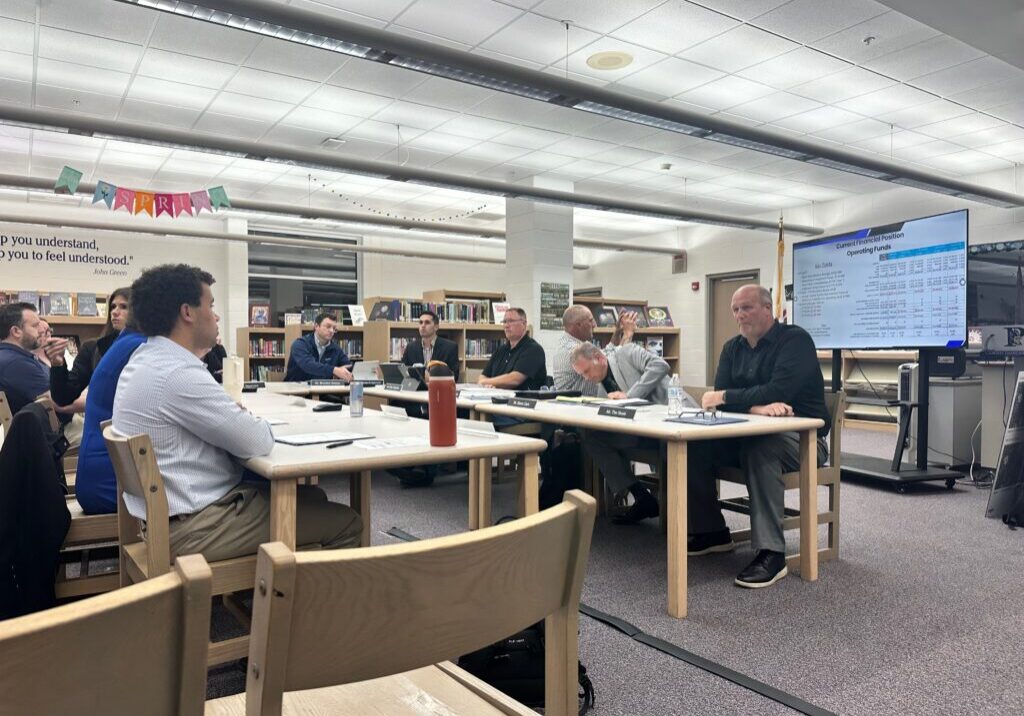
While newly confirmed Superintendent Dr. Mark Cohen watched and took notes, District 207U officials spent hours Monday night reviewing policy updates, financial projections, and long-term facility options, while signaling that any potential referendum remains a distant consideration rather than an immediate plan.
The April 27 committee meeting covered a wide range of topics, but a consistent theme emerged: board members want more clarity on the district’s finances and future direction before asking voters for additional funding.
Policy Updates Move Forward
Administrators presented several policy revisions, most of them technical in nature. Among the more notable changes was an update to the district’s policy on preventing child grooming behaviors, which removes a requirement that parents receive written notice at least five days before related topics are discussed in class.
Other updates included clarifications to drug-free workplace language, adjustments to employee leave policies to account for situations such as neonatal intensive care, and minor grammatical or compliance changes across several policies.
Outgoing Superintendent Brandon Owens indicated the updates will move through the standard approval process in the coming months.
Finances Show Ongoing Deficits
Outgoing Business Manager Adrian Fulgencio, who also resigned at this month’s regular board meeting, outlined a financial picture that, while improving, still includes structural deficits. The district projects a shortfall of about $1.4 million in the upcoming fiscal year, growing to nearly $3 million in later years without further changes.
Recent cost-cutting measures—including staffing adjustments, deferred spending, and operational changes—have reduced projected deficits by several million dollars over the past few months. Still, officials acknowledged the district remains on a “downward trajectory” without new revenue or additional reductions.
Referendum Discussion Remains Preliminary
Board President Dawn Love stated she added a referendum discussion to the agenda, suggesting that education might be the key to the process. Review included timelines and tax impacts.
But Board members Tim Stoub, Steven Clark, and Robert Janeliunas repeatedly stressed the need to identify the district’s true operating costs before making long-term financial decisions.
“We need to know exactly where we’re at before we go to the community,” said Janeliunas.
While the board reviewed how a referendum would work—including timelines and tax impacts—members emphasized that no decision is imminent.
Projections show that a $1 million increase in operating revenue would cost the owner of a median-value home roughly a $343 increase each year, $191 difference from the baseline, with larger increases tied to higher funding requests.
Also, if the district were to seek a referendum to remodel buildings at the lowest cost option of $70 million, homeowners would see a $981 increase and to build, at the high end option of $142 million would be a $1,982 increase on their property tax bill for the next 30 years.
Still, several members pushed back on the idea of moving forward too quickly, particularly with a new superintendent set to begin July 1.
”I think this board in 3 months has almost saved close to $3 million. I think we’re not done figuring that out. I think we can’t know if we need a referendum or not if we don’t know what our capital costs are,” Said Janeliunas.
Board member Jennifer Moe said that learning about the process helps to create a long term plan. Stoub quickly suggested that Moe should know the process after being on the board for 15 years and putting three previous referendums on the ballot to the community.
”In 15 years a lot of laws have changed, and I think we owe it to the community to reeducate, everyone can get a reminder,” said Moe.
Stoub again quickly retorted, “I’m not a fan of your education.”
Both Stoub and Board member Steven Clark said they’ve heard more people talk about the technology fee than a referendum.
Janeliunas chimed in, “I don’t think we can just keep asking for money until we figure out what our operating cost is and what is our future plans?”
Clark agreed, “We need to show the community how we’re spending efficiently and how we’re spending effectively. We can’t just throw money at things.”
Board member. Ashley Stachniak chimed in and reminded the board that the feasibility study for the fields hasn’t been completed. She added, “We can’t borrow land and build a house.”
Fulgencio reviewed financials and said the district is still on a downward trajectory but has now extended the district going into the red by another couple years.
The earliest possible referendum would be November 2026, though multiple members indicated they would prefer to wait longer to allow new leadership to help shape a long-term plan.
Facility Options Narrowing
The board also reviewed multiple long-term facility scenarios, ranging from maintaining current buildings to constructing new schools, with estimated costs between $70 million and $142 million.
Members discussed narrowing the list of options to two or three more realistic choices, noting that early concepts may include features that are not essential.
Stoub suggested exploring a design before a referendum because if the referendum was for $70 million, the design will cost $70 million. He added, “Because if we build it with that in mind, we’re going to build what we need, instead of building to what we have.”
Officials noted that current estimates are preliminary and based on conceptual designs. More detailed planning—and cost refinement—would occur in later phases.
If voters were to approve a project, officials said it would likely take three to four years before completion.
The board continued to discuss ways they could evaluate operating costs for efficiency. Stoub added that he would not make a decision based on fears of cuts.
Clark also added that he wanted to sit down with Buildings & Grounds Director Mike Singleton to review some expenses to see if there was room for saving some costs. Stachniak asked if those costs included overtime and Clark said they did not, that he was evaluating the constant variables and Stachniak added that overtime was a huge variable.
Overall, five board members, Stoub, Clark, Janeliunas, Stachniak, and Mark Jones agreed they did not want to pursue a referendum at this time.
Technology Fee Draws Mixed Reaction
The committee also considered implementing a $50 annual technology fee to support device replacement cycles.
After accounting for fee waivers and unpaid balances, the proposal would generate about $37,000 annually.
Some board members supported the fee as a practical way to maintain technology, while others raised concerns about affordability, especially given existing registration costs.
Board member Ashley Stachniak discussed options such as allowing students to keep devices after several years.
Director of Instructional Technology said the fee could always be scaled back should revenue increase.
Ultimately, the board consensus was to move forward with the$50 technology fee.
Operations and Maintenance Under Review
In an effort to improve efficiency, officials proposed hiring an in-house HVAC technician to reduce reliance on outside contractors. The district currently spends about $144,000 annually on outsourced HVAC services.
The proposed position would cost between $85,000 and $105,000 not including overtime, with potential savings tied to reduced service calls and more preventative maintenance. One of the general maintenance technicians is retiring at a salary of about $65,000 and the HVAC position would replace that retiree.
Clark mentioned that a compressor is down at the high school auditorium and that it’s easily $20,000 to repair, and requires a team. A job that the district could not save money on with the addition of the HVAC technician position. Stoub inquired how much of the cost was preventative and Singleton didn’t have specific numbers. Singleton said that if he had someone on standby, he wouldn’t have to make a list.
Stoub said he was comfortable with approving the position but only if actual numbers of costs were tracked for the last two years, and moving forward after the technician was hired.
Board members expressed cautious support but requested ongoing tracking of costs and savings to ensure the move is financially beneficial.
“If we do this, we need to see the numbers,” Stoub said.
Singleton also brought to committee the costs of two preventative maintenance contracts for the next year; to give a new hire time to get up and running. Singleton presented quotes from Midwest Mechanical for $52,000 and Glade for around $46,000. Midwest offered 24/7, 365 emergency repair with their contract.
Stoub suggested that there was no cost savings in hiring and having the maintenance contract; and he wasn’t interested in spending more to do both. Clark agreed and added that there was additional costs with tools and chemicals.
After porous discussion with board members Stoub and Clark inquiring about the cost savings that could not clearly be identified, agreement was to move forward with spring preventative maintenance, track HVAC expenditures both past and future, and move forward with hiring the HVAC technician.
Consolidation Progress Continues
Administrators provided an update on ongoing school consolidation efforts, reporting approximately $143,000 in cost savings, below the original $300,000 estimate.
Additional planning is underway for student logistics, parking, and building transitions, with more detailed information expected soon. The district is also planning community events to allow residents to tour impacted buildings.
Deliberate Approach Moving Forward
Throughout the meeting, board members emphasized a measured, step-by-step approach to decision-making.
No formal action was taken, with officials indicating that further analysis, planning, and community input will guide the district’s next steps.
Version 2
Here’s a slightly tightened rewrite with a shorter headline, while preserving all quotes:
207U Reviews Finances, Facilities as Referendum Talk Surfaces
Peotone — While newly confirmed Superintendent Dr. Mark Cohen observed and took notes, District 207U officials spent hours Monday night reviewing policy updates, financial projections, and long-term facility planning, making clear that any potential referendum remains a distant possibility rather than an immediate step.
The April 27 committee meeting covered a wide range of topics, but a consistent theme emerged: board members want a clearer understanding of the district’s finances and long-term direction before asking voters for additional funding.
Policy Updates Move Forward
Administrators presented several policy revisions, most of them technical. Among the more notable changes was an update to the district’s policy on preventing child grooming behaviors, removing the requirement that parents receive written notice at least five days before related topics are discussed in class.
Other updates included clarifications to drug-free workplace language, adjustments to employee leave policies to account for situations such as neonatal intensive care, and minor grammatical or compliance revisions.
Outgoing Superintendent Brandon Owens said the updates will move through the standard approval process in the coming months.
Finances Show Ongoing Deficits
Outgoing Business Manager Adrian Fulgencio, who also resigned at this month’s regular board meeting, outlined a financial outlook that, while improving, still includes structural deficits. The district projects a shortfall of about $1.4 million in the upcoming fiscal year, growing to nearly $3 million in later years without further changes.
Recent cost-cutting measures—including staffing adjustments, deferred spending, and operational changes—have reduced projected deficits by several million dollars. Still, officials acknowledged the district remains on a “downward trajectory” without new revenue or additional reductions.
Referendum Discussion Remains Preliminary
Board President Dawn Love said she added a referendum discussion to the agenda, suggesting education may be key to the process. The review included timelines and potential tax impacts.
Board members Tim Stoub, Steven Clark, and Robert Janeliunas repeatedly emphasized the need to fully understand operating costs before making long-term financial decisions.
“We need to know exactly where we’re at before we go to the community,” said Janeliunas.
While the board reviewed how a referendum would work, members stressed that no decision is imminent.
Projections show that a $1 million increase in operating revenue would cost the owner of a median-value home roughly $343 per year, a $191 increase from the baseline. Larger funding requests would raise that amount.
If the district pursued a referendum for facility improvements, estimates showed a $70 million project would increase property taxes by about $981 annually, while a $142 million project would increase taxes by about $1,982 annually for 30 years.
Still, several members cautioned against moving too quickly, especially with a new superintendent set to begin July 1.
“I think this board in 3 months has almost saved close to $3 million. I think we’re not done figuring that out. I think we can’t know if we need a referendum or not if we don’t know what our capital costs are,” said Janeliunas.
Board member Jennifer Moe said learning about the process helps create a long-term plan. Stoub responded that Moe should already understand the process after 15 years on the board and involvement in three prior referendums.
“In 15 years a lot of laws have changed, and I think we owe it to the community to reeducate, everyone can get a reminder,” said Moe.
Stoub replied, “I’m not a fan of your education.”
Both Stoub and Clark said they have heard more public discussion about a proposed technology fee than a referendum.
“I don’t think we can just keep asking for money until we figure out what our operating cost is and what is our future plans?” Janeliunas said.
Clark agreed, adding, “We need to show the community how we’re spending efficiently and how we’re spending effectively. We can’t just throw money at things.”
Board member Ashley Stachniak pointed out that a feasibility study for athletic fields has not been completed, adding, “We can’t borrow land and build a house.”
Fulgencio said the district remains on a downward trajectory but has extended the timeline before reaching a deficit by a few years.
The earliest possible referendum would be November 2026, though several members indicated a preference to wait longer.
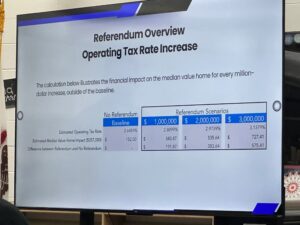
A slide from the 207U Committee of the Whole meeting. Photo by Andrea Arens.
Facility Options Narrowing
The board reviewed long-term facility scenarios ranging from maintaining current buildings to constructing new schools, with estimated costs between $70 million and $142 million.
Members discussed narrowing the options to two or three more realistic choices, noting that early concepts may include nonessential features.
Stoub suggested developing a design before pursuing a referendum.
“Because if we build it with that in mind, we’re going to build what we need, instead of building to what we have,” he said.
Officials noted current estimates are preliminary and based on conceptual designs, with more detailed planning to come later. If approved, a project would likely take three to four years to complete.
Board members also discussed evaluating operating costs for efficiency. Stoub said he would not make decisions based on fears of cuts.
Clark said he wants to meet with Buildings & Grounds Director Mike Singleton to review expenses for potential savings. Stachniak asked whether overtime was included; Clark said it was not, focusing instead on fixed costs, and Stachniak noted overtime is a significant variable.
Five board members—Stoub, Clark, Janeliunas, Stachniak, and Mark Jones—agreed they do not want to pursue a referendum at this time.
Technology Fee Draws Mixed Reaction
The committee also considered a $50 annual technology fee to support device replacement. After waivers and unpaid balances, the fee would generate about $37,000 annually.
Some members supported the fee as a practical solution, while others raised concerns about affordability.
Stachniak discussed options such as allowing students to keep devices after several years. The Director of Instructional Technology noted the fee could be reduced if revenues improve.
The board reached consensus to move forward with the $50 fee.
Operations and Maintenance Under Review
To improve efficiency, officials proposed hiring an in-house HVAC technician to reduce reliance on contractors. The district currently spends about $144,000 annually on outsourced HVAC services.
The proposed position would cost between $85,000 and $105,000, not including overtime, and would replace a retiring maintenance technician earning about $65,000.
Clark noted a failed compressor at the high school auditorium would cost about $20,000 to repair and require a team—work unlikely to yield savings even with an in-house technician. Stoub asked how much current spending is preventative; Singleton did not have specific figures but said having staff on standby would streamline repairs.
Stoub said he would support the position only if cost data is tracked.
“If we do this, we need to see the numbers,” Stoub said.
Singleton also presented preventative maintenance contract options: $52,000 from Midwest Mechanical, which includes 24/7 service, and about $46,000 from Glade.
Stoub questioned the value of both hiring and maintaining a contract, and Clark noted additional costs for tools and materials. After discussion, the board agreed to proceed with spring maintenance, track HVAC costs, and move forward with hiring the technician.
Consolidation Progress Continues
Administrators reported approximately $143,000 in savings from school consolidation efforts, below the original $300,000 estimate.
Planning continues for student logistics, parking, and building transitions, with more details expected soon. Community tours of affected buildings are also being planned.
Deliberate Approach Moving Forward
Throughout the meeting, board members emphasized a measured approach.
No formal action was taken, with officials indicating that further analysis, planning, and community input will guide next steps.





Mostly Sunny